
Defining Word: Community
Story by Rebecca Marie, photography by Kym van der Plas
Defining Word: Community
Community: people living in one particular area or people who are considered a unit because of their common interests, social group or nationality
I used to work as a Clinical Psychologist Registrar in private practice. My bio on the website said, “Rebecca has an interest in perinatal mental health.” I don’t have specific training in perinatal mental health, but I do have training in trauma, and the two seemed to go hand in hand. Week after week, postpartum women wept on my couch. They recited litanies of traumatic childhoods, traumatic births, romantic relationships fraying under strain, feeding difficulties, sleep deprivation, and colicky babies. I asked, “Who are the people you can call on? Who came to the hospital with you? Who can hold your baby while you take a nap?” Week after week, weeping women looked at me blankly. Their looks communicated, What do you mean, other people? There is no village. I am alone. What kind of psychologist are you? Don’t you listen? I need strategies! Week after week, I told them, “I’m not surprised you are depressed.”
Lavoir. I recently learned about lavoirs, which is the French term for wash-houses. A wash house was a place where women in the village came together to do their laundry. Napoleon III, the nephew of Napoleon Bonaparte, was the French emperor in the mid-1850s. In 1851, he ordered the construction of lavoirs across the country as part of a public health program to eradicate cholera and typhoid. This institution completely changed the lives of poor French women. Women would soak, agitate, and boil the linens at home, which was a day’s work. Then they carted the linen to the lavoir, which tapped a source of fresh flowing water. A basic lavoir was a hole in the ground with stone slabs around the edge where women could scrub and beat the clothes. Fancier lavoirs had raised stone sinks where women could stand and work. It was not unusual for up to twenty women to work at the lavoir at one time, helping each other wring out sheets and linens. These days, we just put the clothes in the washing machine, add washing powder, press a few buttons, and leave.
Nine years ago when I was six months pregnant with my first son, we did as you do and bought a house. We moved to a new neighbourhood, a fifty-minute drive from all my friends. We started going to a church in our neighbourhood when my first son was six months old, which was all new to me. All my friends were physically far away. I wasn’t working or studying that year, so all the people in my wide network were suddenly on different schedules. I didn’t join a mothers group because I had been a part of an amazing women’s Bible study at my old church. But when my six-month-old decided to scream for the whole drive to my old church, I had to turn my sights local—no women’s Bible study, no mothers group, no friends with babies. And then I was home alone with a six-month-old from 8am - 6pm day after day after day. Sometimes I just sat on the floor and stared at him, wondering what I was supposed to be doing, if I was doing it right, while the silence echoed all around us.
A few years later, I was at the park on our street at 5.30pm hoping to kill 45 minutes before my husband got home from work. At this point, I had two boys, who were about two and four years old. They had energy to burn after being cooped up in the aircon to avoid the midday scorch. We watched as ladies ran towards the footy goal posts: sandals off, fabric billowing, hijabs shoved off sweaty cheeks. And the children! A mob of children galumphed in their wake across the park. My boys were the haphazard dregs of this motley procession. When the ladies reached the goals, they turned and ran back. Some kids kept running towards the goals, others turned with the ladies, and some, like my son George, fell flat on their nappy-clad bottoms, threw their hands in the air, and laughed while sprinkling a chorus of crumbs. I sat on the park bench in the shade, but my Hazara neighbour, Sarah, put me to shame. After running, she waved to me while walking laps of the park’s perimeter with her friend, calling out that she was working on her postpartum belly. A rag-tag group of Hazara kids played on the playground. Later, the ladies offered me cardamom tea from their sealed plastic teapots and dainty desserts. There was something beautiful in the way that the Hazara ladies did life together: simple exercises, cups of tea at the park, and sharing childcare. Life didn’t seem compartmentalised, like driving to a coffee shop to see a friend and then driving in a different direction to a gym class. I know they have had many other problems, but I suspect the park ladies didn’t experience the same loneliness when their babies were born.
A few years after that, I was pregnant with my third baby and working two days a week in private practice. My childcare arrangement fell through for one of the days, but I had four months to go before I went on maternity leave. My friend Michelle babysat my youngest son, George, on Fridays for four months. When she offered, I fought with her and said I couldn’t accept it, I couldn’t trade anything back in that season, but she argued, “This is a gift, why can’t I give it to you?!”
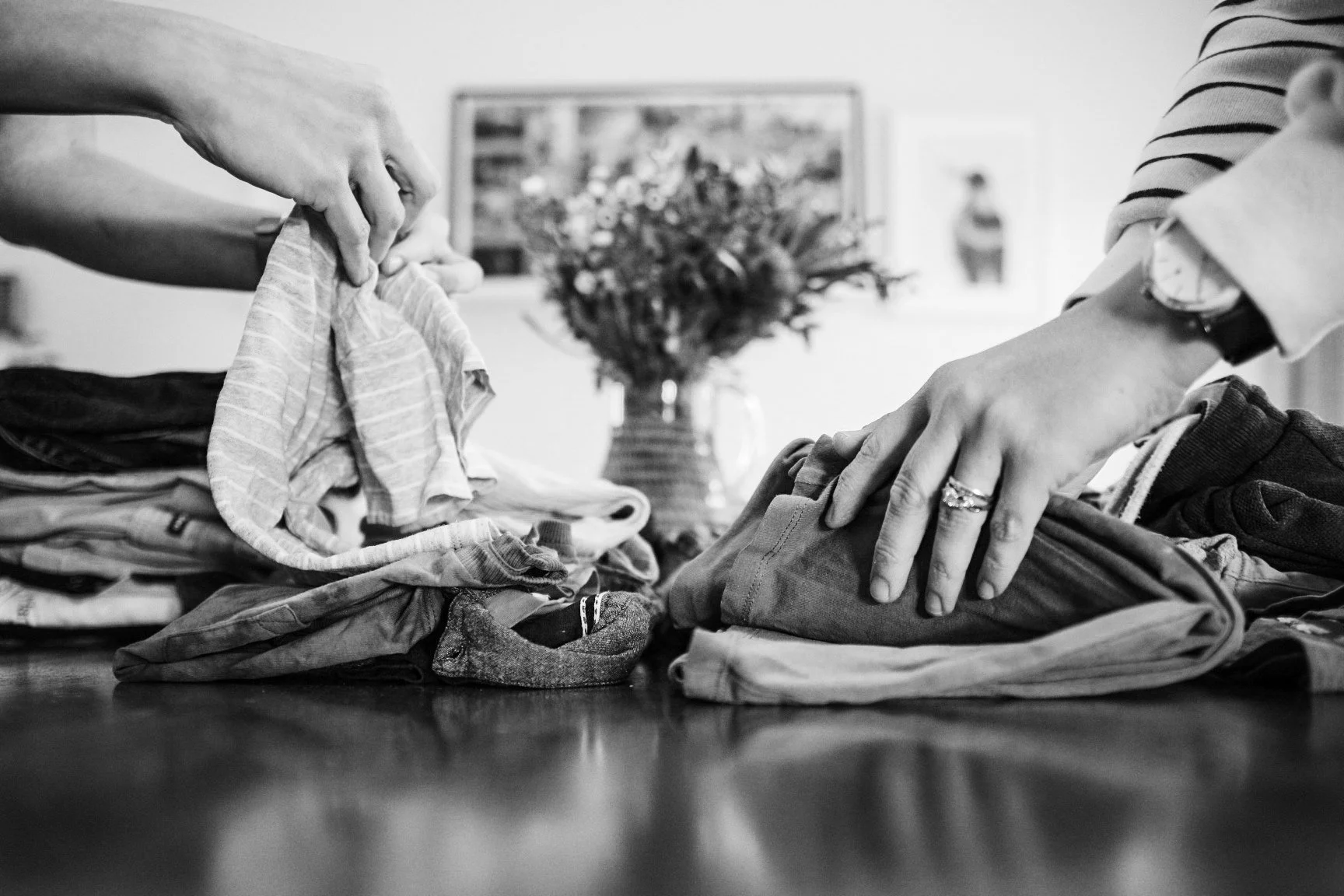
Maybe a year later, I was home with all three boys, and my friend Ash texted me that her washing machine was broken and asked if she could do a load of laundry at my place. When she came over, she offered to help me fold my laundry while we waited for her load to finish. We drank coffee, demolished half a loaf of yesterday’s banana bread with butter, and in no time at all my washing was folded and put away, hers finished in the dryer, and neatly folded in a basket on the backseat of her car.
While camping on the school holidays with a mob of children, my friend Tinson shared that she was trying to work out a routine now all her kids were in school. I told her about my recent life-changing revelation, which I’m sure everyone else had worked out, but Food Shop Day ™ is now Monday. I’d always smush food shopping higgledy-piggledy into my week, wherever I had free time. I suggested she go food shopping with me on Mondays. For a term, we made our way around the aisles, cackling and discussing what we were making for dinner that week and how to make our dollars stretch further. Sometimes we got coffee afterwards with my friend Rach, who also shopped on Mondays. Other weeks, we talked over the top of my toddler, who was in desperate need of a nap, while we pushed our trolleys to our cars.
One Sunday after church, I saw my friend’s son, who is the same age as my oldest son, walking off to the park across the road from the church with an older boy and a footy. I called him back and asked if his Mum said he could go to the park. He said yes but I told him to stay at church. Later, I texted my friend who confirmed that her son is definitely not allowed to leave church and she didn’t know he was going. She said, “Thank you for knowing me.”
Every now and then, I think about the fact that the limitless God, the prophesied King, came to earth in a body. As Hannah Anderson said, “A body is a set of limits.” Our bodies are limited by our need for rest. Our bodies are limited by our need for food. Our bodies are limited by our need for community.
I adore my washing machine. It saves me time and hard physical labour. But I wonder, now that we’re not physically working together, carting linens to the lavoir and wringing sheets, how tempting is it to assume we don’t need each other on a daily basis? Perhaps it is our time in history, maybe it is the sinful bent in every human heart and reinforced year after year after year, but often it seems easier to swallow the lie, I don’t need help. But with three children in tow and thirty-seven fast approaching on the calendar, here is what I realise: I don’t need to compartmentalise my life. We all need to manage our households. Why can’t we do it together? Maybe instead of texting a friend to meet at a coffee shop, we could invite them into our very mundane, everyday lives?
This prompt is inspired by Amy Krouse Rosenthal’s Textbook but I saw Ashlee Gadd do it first. See her take on it here.
If this story resonated with you, sign up to get honest stories in your inbox for free on Wednesdays from Christian women in Western Australia from March—November 👇🏻
Rebecca Marie - Founder of Stories I’d Tell You at Dinner
Rebecca is married to Zac and they have three boys. She became a Christian at 18 years old after someone read the gospel of Luke with her. Trained as a Clinical Psychologist, she is the founder of Stories I’d Tell You at Dinner and The After Dinner Mint podcast. She is a regular contributor to Part Time Poets and The Gospel Coalition Australia. Her spiritual gift is losing things. You can read more at The Sunday Morning Snuggle.