
Essay and photo by Khaiah Thomson
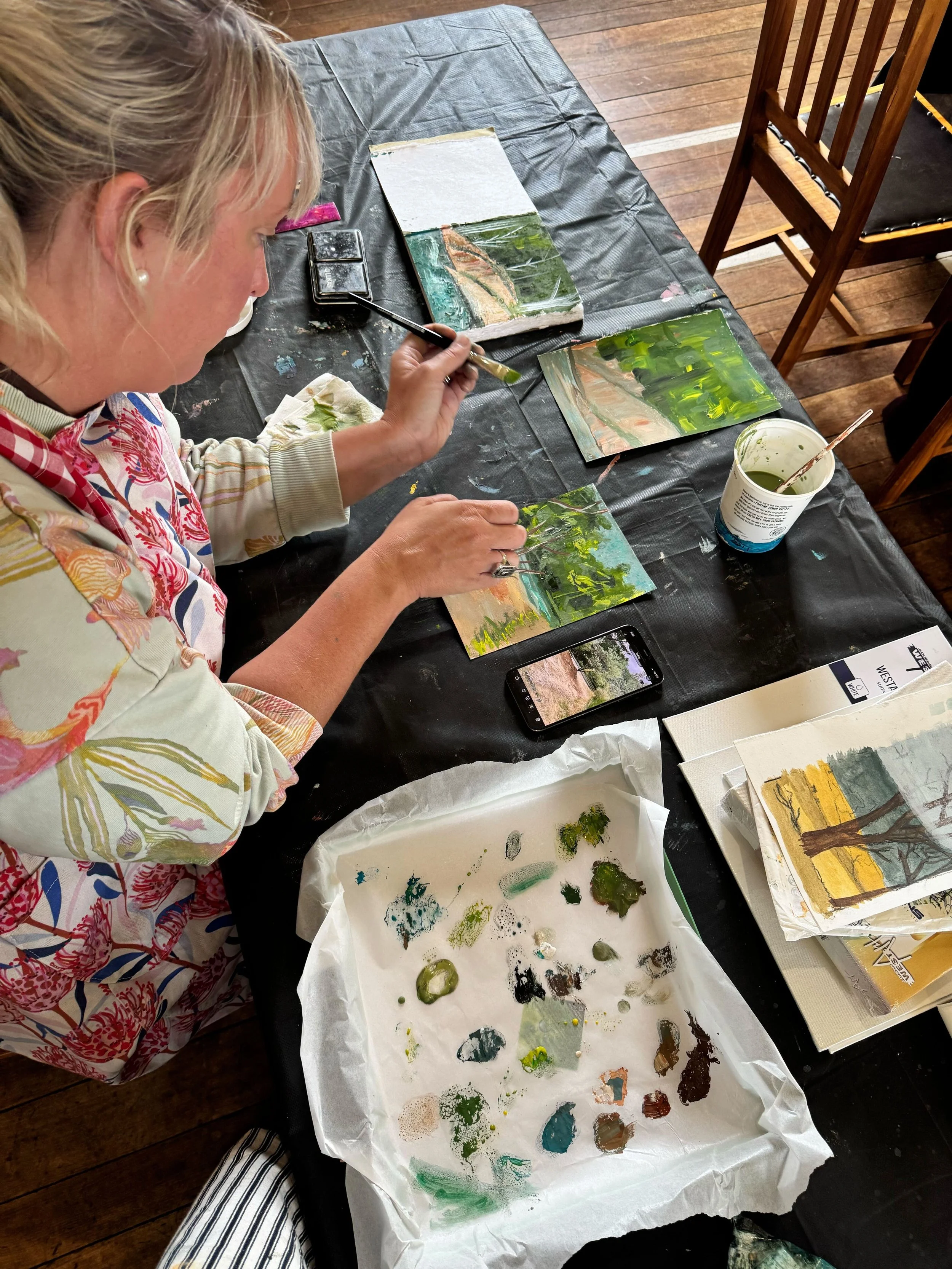
Last month, I had the opportunity to attend an art retreat in northeast Tasmania with my sister. She is an artist, and a very good one at that. My own artistic experience, however, was limited to high school art class, a paint-by-numbers kit, and a paint-and-sip evening with colleagues.
The retreat had been pitched to me as a relaxed and flexible do-what-you-want kind of gig. So rather than feel daunted by trying something completely new, I devised a simple plan: I would discover a hidden natural talent and amaze everyone, or failing that, I’d use the time to get some writing done.
A Different Creative Language
Part of me expected that because writing and painting are both creative pursuits, that they’d share a common language. I expected that art, in this case painting, would make sense to me, that it would follow the same breakable rules as writing, that provide guidance when learning your craft. Instead, I discovered that painting landscapes required me to learn a completely new language with its own logic and conventions.
It was mind-boggling.
The art retreat took place in the small town of Winnaleah. On the first day, I walked into the town hall, our makeshift studio, and immediately felt intimidated. Our tutor, David, had one of his paintings on display: a stunning seaside landscape. He was a multi-award-winning artist, and it showed.
As I took my seat, a growing sense of foreboding settled in my chest.
The day passed with me staring at paper, brushes, and gouache paints, trying to work out how to combine them into something resembling art. The toll it took on my brain felt less like creativity and more like solving a complex mathematical equation. Even David seemed perplexed, asking if I truly had no painting experience. Eventually, with furrowed brows, he suggested I try watercolours.
By the end of the day, I’d produced an overworked little painting of nearby fields. After dinner, I fell into bed, exhausted, and dreamed of watercolours blending into an unholy brown sludge.
Learning to See Differently
On day two, we drove to the Ringarooma River just outside of Derby, a small town known for its world-class dirt bike trails. I pocketed a few smooth river stones for my ever-growing assortment of treasures back home and found a spot by the water, waiting for inspiration to hit me, hopefully square in the face where I wouldn’t miss it. I even did a little finger framing, like a true expert, to help me visualise my future masterpiece (turns out taking a picture on your phone and cropping it is just as helpful and doesn’t feel as silly).
My sister offered a simple piece of advice: focus on shapes and colours, not details. Squint, she said. Blurring your vision can help to simplify the scene and help you focus on key structures.
This was surprisingly difficult—not the squinting, I was a pro at that—but ignoring the detail. In writing, I rely heavily on detail to show rather than tell. Pulling back, softening focus, and observing only shapes, colours, and tonal contrast felt unnatural.
Still, I tried.
By the end of the day, after much skilful squinting, I had something on paper. But it was missing something. I asked my sister for help, and with a few confident strokes, she added streaks of pink and black to the trees.
The painting transformed instantly.
‘Remember to focus on shapes and colours,’ she reminded me.
But pink? I never would have thought of that.
A Shift in Perception
Something magical happened on day three.
I began to see more. In everything.
Pink streaks in tree bark. Purple shadows in rippling turquoise water. Blue and violet tones in rocks scattered along the sea shore, covered in lichen glowing orange, yellow, and fluorescent green. Even the mountains were tinted a hazy blue that deepened with distance.
Back at the studio I experimented with braver colours and shapes. It wasn’t a masterpiece but I was getting somewhere.
The Struggle to Loosen Up
Day four brought a familiar frustration. I could now see the shapes and colours, but I still couldn’t translate them onto the page. Once again, I became stuck.
Both my sister and David encouraged me to try being looser…I was getting caught up in the finer details again.
Loose? What does that even mean?
I’ve never been a particularly “loose” person. I do kid myself at times and like to think I’m a relaxed person, but my brain is always running at a million miles an hour, searching for flaws, errors, spelling mistakes, a book in the wrong spot on my bookshelf and anything out of place. I exist somewhere between slightly tense and moderately tense at all times. During my first pregnancy, a physiotherapist repeatedly told me to relax my pelvic floor…apparently, even that part of me doesn’t understand looseness.
That evening, I abandoned painting altogether. Sitting in the backyard, watching pollen-drunk bumblebees roll around in the artichoke flowers with a carelessness I envied, I wrote a poem about the town in which we stayed. Writing felt safe. Controlled. No looseness required.
Letting Go
By day five, I’d accepted that I wouldn’t be producing anything award-worthy anytime soon. So, I let go of the expectation.
Sitting on the cliffside above Little Blue Lake, while being enthusiastically attacked by ants, I began to doodle with a fine pen and watercolours.
And somehow, finally, I loosened up.
And I enjoyed it.
Back in the studio, David sat beside me, a broad grin spread across his face.
‘Yes, this,’ he said, pointing at my sketchbook. ‘This works for you. This is what you should focus on.’
A New Way of Seeing
I can’t pinpoint exactly what changed. Maybe it was simply letting go of expectation, but something shifted. I even completed another small watercolour later, just for fun.
More importantly, I left the retreat seeing the world differently. It’s changed the way I see things; ordinary, everyday things.
Now, when I walk the dog at night, I notice how streetlights alter the colours of trees, how the sky shifts through shades of orange, blue, and purple. And the clouds—there are so many colours in the clouds! Ordinary moments feel richer, more layered.
Beyond Art
When I sat down to write this, I realised the lesson extended far beyond painting. It was one of those quiet ah-ha moments, where God uses an ordinary experience to reveal something deeper and more meaningful.
There are times when focusing on detail is essential. Precision has its place, and care matters. But there are also times when that same attention to detail becomes overwhelming. When overthinking and constant “nit-picking” turn suffocating, trapping you in a cycle of trying to get everything right.
In those moments, maybe the answer is to loosen up (try not to shudder at the thought) and approach life with more relaxed brushstrokes. To soften your focus. To step back and notice the broader shapes, the contrasts, the colours, and the textures that make up the bigger picture.
After the birth of my first son, I struggled to adjust to the responsibility of caring for a small, growing human. This was made worse by the lack of sleep and sudden, total change in lifestyle. When he was 12 weeks old, I went to see my GP feeling overwhelmed and convinced I was doing everything wrong, that I was a bad parent.
My milk had dried up and I’d switched to formula. I didn’t have a set feeding and sleep routine. I let him use a dummy. And sometimes I let him cry. Just a few of the many things that felt like evidence that I was a failure.
The GP listened and smiled. With a kind understanding he asked me three simple questions: Is he fed? Is he loved? Are his basic needs met? If the answer to those is yes, he said, then you’re doing it right.
It felt too simple to be true. It couldn’t be that simple, right?
I’m a social worker on an acute ward in one of Perth’s major hospitals. The people I work with often have life-altering, and in many cases, life-limiting diseases. It’s easy to become bogged down by a flaw in your body and let it define you. I say this with certainty because I share a chronic condition with some of the people I support (though that’s a story for another time).
In the world of chronic illness, there seems to be a stark contrast between who I think of as “squinters” and “non-squinters.” There are those who can’t see past their disease—those whose lives are controlled by it and revolve around it. It’s so easy to fall into this trap. Then there are those who focus on the bigger picture: people who undergo whatever treatment is necessary and are eager to get back to their everyday lives. Yes, their disease is life-changing. Yes, it’s scary and uncertain. But it’s only one part of their lives, and they choose to focus on what lies beyond it.
I understand that it’s not always this black and white. It certainly isn’t for me. Still, I hope to learn from the “squinters” and I’m grateful that my faith encourages me to do so: “Therefore do not worry about tomorrow, for tomorrow will worry about itself. Each day has enough trouble of its own.” (Matthew 6:34)
I’ve found that the shift in perception and focusing on key structures reveals what truly matters. The bigger picture has a way of quieting the noise and reminding me that not every detail requires scrutiny or excessive rumination. It may feel unnatural at first (it still does for me). It may require unlearning habits and embracing a different way of thinking. But it is, without a doubt, refreshing.
Sometimes, you just need to squint—and let the rest reveal itself.
If this story resonated with you, sign up to get honest stories in your inbox for free on Wednesdays from Christian women in Western Australia from March—November 👇🏻
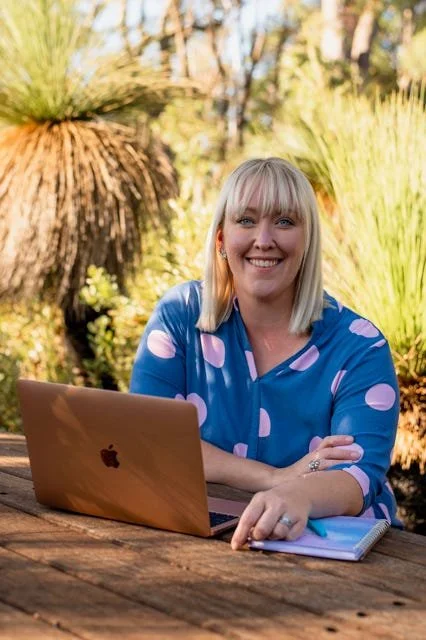
Khaiah Thomson—Regular Contributor
West Australian Author Khaiah Thomson pens the Blackwood series. The first book Welcome to Blackwood won the Hawkeye Publishing Manuscript Development Prize in 2020. Khaiah first decided to write young adult fiction novels as a way to exercise her brain while on maternity leave. She wanted to create a magical escape for young readers, all the while gently weaving in themes of God’s love through the timeless battles of good versus evil, unconditional love and the power of redemption.
Khaiah lives in Perth with her husband and two sons. When she isn't working or in her home office writing, Khaiah can usually be found nose-deep in a book, gaming or at the nearest cafe, hovering close to the coffee machine. Khaiah’s Welcome to Blackwood series can be found in all good bookstores and Hawkeye Books.